Support Innovation Group (SIG) Workflow and Approval Process
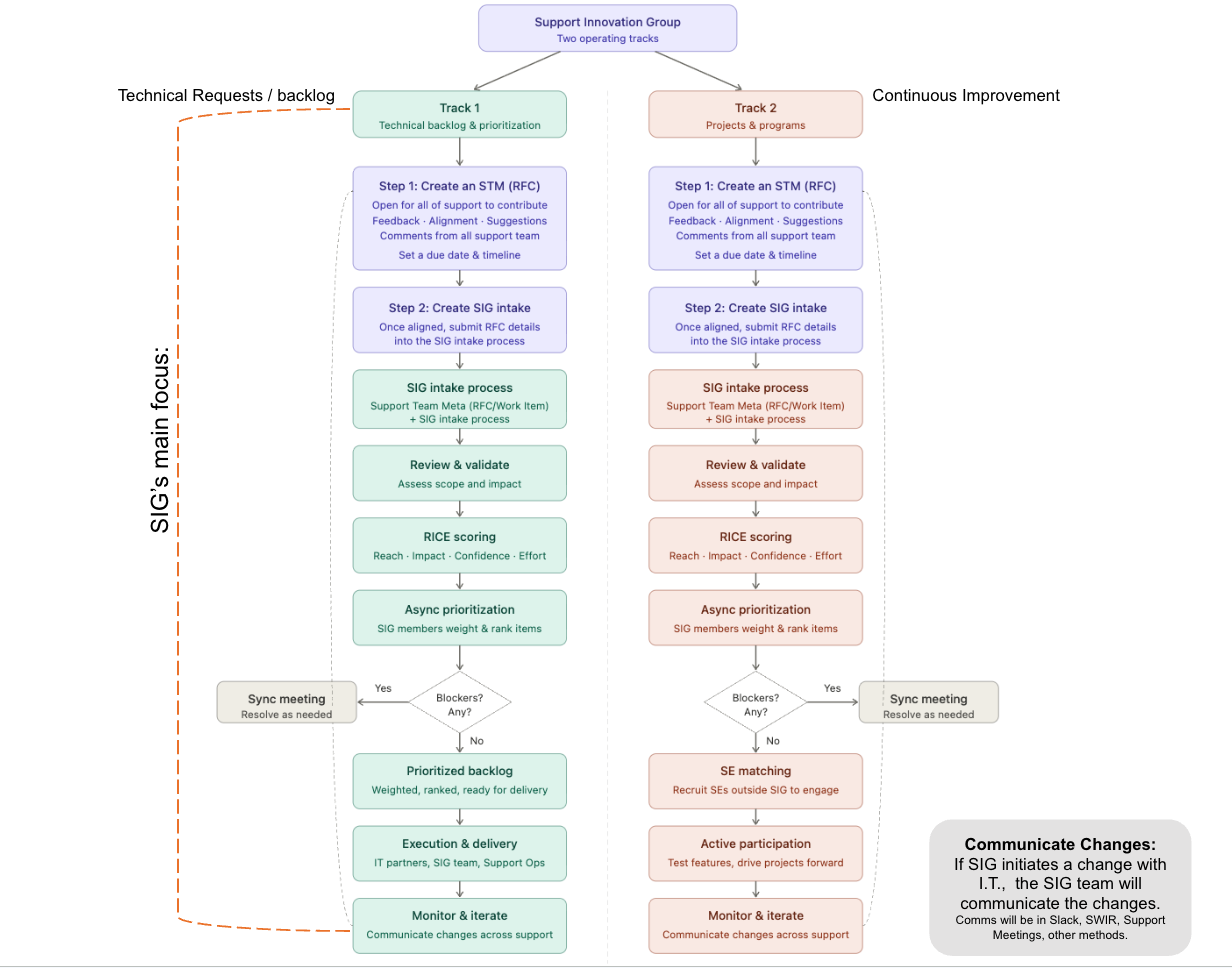
This page describes the Support Innovation Group (SIG) workflow and approval process for submitting, reviewing, and approving ideas.
SIG connects the Support team with IT and Product teams, to make sure we have the right tools and improvements to do our jobs well. We identify opportunities, define what we need, validate solutions, and help the team adopt what gets built.
SIG and Support Ops (IT) work in close partnership —
This section has been created to help simplify the process, help to understand the Role of the SIG team Lead, as well as the SIG Team members:
Anyone can create an Intake Request through the SIG Intake Request Form.
The SIG Team Lead works with Support Leadership around prioritization of SIG Requests. The Priority is based on What’s in Process, and What’s up Next. The Slack Channel #spt_leadership_internal will be used to request the prioritization. We will set priority based on R.I.C.E Scoring on a weekly list, and ask if changes need to be made.
SIG Team Members will:
From there, the SIG Team Lead will get involved, and work with CSS on the Roadmap/Capacity Planning.
The SIG Team Lead is responsible for Messaging, and Communications.
A valid SIG request addresses a digital or tooling challenge that is strategic in scope, scalable in impact, and requires cross-functional delivery. It should relate to systems, automations, AI, workflows, reporting, or integrations that power Support’s work — and demonstrate meaningful impact on core KPIs such as handle time, CSAT, deflection, or backlog.
Valid requests align to one or more of SIG’s strategic epics, including automation & AI adoption, self-service expansion, engineer efficiency, customer experience, management reporting, cross-organizational collaboration, or third-party integrations. They require involvement from IT, Engineering, Product, or external vendors to design, build, and ship.
Critically, a valid SIG request is framed as a problem to solve — not a pre-defined solution — with clear articulation of impact and measurable success criteria. Requests that are narrowly scoped to a single team, lack strategic alignment, or can be resolved without cross-functional effort are out of scope for SIG.
A request is out of scope for SIG if it is purely local, operational, or people-focused with no digital or tooling component. This includes staffing and scheduling asks, training and enablement items covered by existing programs, one-off configuration fixes, or standard feature and bug requests that belong in Product or Infra backlogs.
Requests that are too vague to define impact or success criteria — or that benefit only a single individual or small team — are equally out of scope. If it can be solved with a SOP, a training module, or a routine ticket, it’s not a SIG request.
EXAMPLE
This is a valid SIG request if:
This is Not a valid SIG request if:
SIG Support team members will:
fd72b040)
